
It is usually a form of wear and tear that progresses and does not go away on its own. With treatment, however, many dogs enjoy a good quality of life for a long time.
Cauda equina syndrome in dogs: symptoms, diagnosis, outlook
Table of contents
- What is cauda equina syndrome in dogs?
- Which dogs are affected?
- How do I recognise cauda equina syndrome?
- When should I see the vet immediately?
- How is cauda equina syndrome diagnosed?
- How is it treated?
- What happens next, and what is the life expectancy?
- What helps in everyday life?
- Frequently asked questions
- Sources
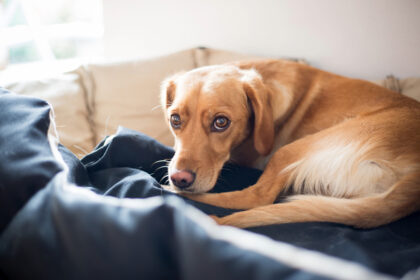 Cauda equina syndrome in dogs develops when the nerve roots at the end of the spine, where the lumbar spine meets the sacrum, are compressed. Typical signs are above all pain in the lower back that shows when getting up, jumping or climbing stairs. In most cases, the cause is wear and tear at this point, known as degenerative lumbosacral stenosis. In particular, it affects middle-aged to older, medium to large and active dogs, especially German Shepherds.
What is cauda equina syndrome in dogs?
“Cauda equina” is Latin for horse’s tail. That is why this is the name for the bundle of nerve roots at the end of the spinal cord inside the vertebral canal, which supplies the hind legs, tail, bladder and bowel. At the junction between the last lumbar vertebra and the sacrum, the lumbosacral junction, these nerves leave the spine.
Over the years, the disc at this point can wear and bulge. In addition, ligaments may thicken and bony growths may form. As a result, the vertebral canal narrows, so the nerve roots are irritated or compressed. Specialists then speak of degenerative lumbosacral stenosis (DLSS). Other, rarer causes include injuries, disc infections, tumours or congenital malformations.
Which dogs are affected?
The condition most often affects middle-aged to older dogs of medium to large breeds that are very active. German Shepherds come first, often as working or sports dogs; retrievers are also frequently affected. However, why exactly the disease develops has not been fully clarified. Heavy strain and a hereditary predisposition are discussed. Also, a known risk factor is so-called transitional vertebrae, a malformation at the lumbosacral junction that can be seen on X-rays.
How do I recognise cauda equina syndrome?
| Common | Less common, usually later |
|---|---|
| hesitates to jump, for example into the car or onto the sofa | lameness in one or both hind legs |
| avoids stairs | weakness in the hindquarters |
| pain when getting up after lying down | tail hangs low and moves less |
| suddenly groans or yelps | difficulty holding urine or faeces |
| is sensitive when the lower back is touched |
When should I see the vet immediately?
The signs often begin gradually and come and go, similar to lumbago. Therefore, if your dog has back pain, have it examined by a vet soon. Take your dog to the practice or clinic immediately if it suddenly can no longer walk properly, drags its hind legs or can no longer hold urine and faeces.
How is cauda equina syndrome diagnosed?
First, there are questions about the symptoms and a thorough examination, including a neurological one. However, compression of the nerves can only be confirmed with cross-sectional imaging. The best method is magnetic resonance imaging (MRI), sometimes combined with computed tomography (CT).
A normal X-ray, on the other hand, is not enough. A study by the University of Zurich in police dogs shows that changes such as spondylosis or a step between the lumbar vertebra and the sacrum were also found in many dogs without symptoms. Conversely, a dog can be in pain even though the X-ray looks normal. In addition, precise imaging helps to rule out other causes of back pain.
How is it treated?
- Without surgery (conservative): pain-relieving and anti-inflammatory medication, rest at first, then gradually more exercise, initially only on the lead. After that, the dog often has to give up wild play and jumping for good. For some dogs, injections into the area around the spinal cord are an option. Also, a normal body weight is recommended. Physiotherapy and an underwater treadmill can be useful; how well they work has not been studied much yet.
- Surgery: mainly when neurological deficits are present or conservative treatment is not enough. The compressed nerves are relieved, for example by removing bone or disc material. Sometimes the junction is also stabilised.
- Which approach? Which approach is better has not been clearly established scientifically. Your vet will decide together with you based on the findings.
What happens next, and what is the life expectancy?
Many dogs can be treated well. However, the disease usually progresses, and relapses are possible with both treatment approaches. In addition, in some dogs, up to 20 percent according to a British specialist clinic, neither medication nor surgery helps sufficiently.
Therefore, life expectancy in years cannot be stated in general terms. What matters is how well the pain can be treated and whether paralysis or incontinence develop. Still, in the Zurich study, working dogs with mild signs were still able to work for a longer time, partly with reduced workload.
What helps in everyday life?
- Keep an eye on weight: a normal weight relieves the back and is explicitly recommended by specialist clinics.
- Avoid jumping: a ramp into the car, help onto the sofa and bed, avoid stairs where possible.
- Steady exercise instead of rough play: calm, regular walks on the lead, as agreed with your vet.
- Non-slip floors: rugs or runners on smooth tiles and parquet.
- Physiotherapy: an animal physiotherapist can show you exercises to continue at home.
Frequently asked questions
Can cauda equina syndrome be cured?
Is cauda equina syndrome the same as spondylosis?
No. Spondylosis means bony bridges between vertebrae. It also occurs in dogs without symptoms and therefore does not prove cauda equina syndrome.
Can it be seen on an X-ray?
Only to a limited extent. X-rays can show clues and risk factors such as transitional vertebrae. Whether the nerves are compressed is only shown by MRI or CT.
Can my dog still do sport?
That depends on the findings. Steady exercise and avoiding jumps and sudden stops are usually advisable. Discuss this with your vet.
Sources
- Steffen F., Hunold K., Scharf G., Flückiger M. (Vetsuisse Faculty, University of Zurich): Degenerative lumbosacral stenosis (cauda equina syndrome) in the German Shepherd (in German). Scientific supplement of the Albert Heim Foundation, Hunde 11/2008.
- Anderson Moores Veterinary Specialists: Owner Information Sheet: Degenerative Lumbosacral Stenosis.
A dog with back pain needs one thing above all: your attentive eye. After all, the sooner you notice changes, the more you and your vet can do for him.
Read more: Vitamin B for dogs · Paralysis in dogs · Wedge vertebrae in dogs

From our range: DOG FIT by PreThis® VITAMIN B. Complementary feed for dogs with all eight B vitamins: B1, B2, B3, B5, B6, biotin, folic acid and B12 as methylcobalamin. Vegan, free from artificial additives. You can find it in our shop.

Our daily inspiration is the special moments with our dogs. Here we share this enthusiasm and invite you to become part of the DOG FIT community on our social media channels.
The content of the articles is for general information purposes only and does not replace diagnosis or treatment by a veterinarian. This information does not constitute medical advice and should not be construed as such.
Comment area
We look forward to your comment


Weitere Beiträge


