
Usually not, even though it looks similar. The most common form has no identifiable cause and affects the balance system in the ear and nerve area. What it really is will be clarified by the vet.
Vestibular syndrome in dogs: signs, causes and outlook
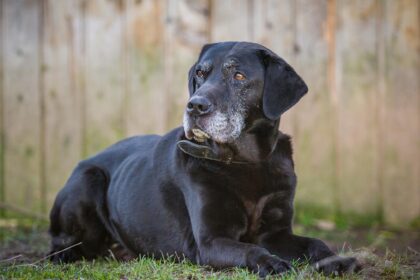 With vestibular syndrome in dogs, the balance system is disturbed. The signs usually appear suddenly: the head tilts, your dog staggers, falls to one side or walks in circles, and the eyes flick back and forth. It often affects older dogs, and frequently no cause is found. In many dogs this form improves after just a few days. Because serious causes can also be behind it, your dog should still see the vet promptly.
What is vestibular syndrome in dogs?
The vestibular system helps your dog keep his balance and move safely. It includes the balance organ in the inner ear, the nerve to the brain and areas within the brain itself. If any part of it is disturbed, his balance is thrown off. Vets therefore distinguish whether the problem lies in the ear and nerve (peripheral) or in the brain (central). Vestibular syndrome is not a single disease, but a pattern of typical signs with various possible causes.
How do you recognise vestibular syndrome?
- Head tilt: Your dog holds his head clearly tilted to one side.
- Eye flicking: The eyes move jerkily back and forth; vets call this nystagmus.
- Balance: He staggers, falls to one side, walks in circles or seems disoriented.
- Getting up: He doesn’t want to stand up or walk.
- Nausea: He feels sick, vomits or eats poorly.
Possible causes
| Cause | Typical features |
|---|---|
| No identifiable cause (idiopathic) | Most common form, usually in older dogs. In a study of 188 dogs with a problem in the ear and nerve area, this applied to 68 %, and on average these dogs were about seven years old. |
| Middle or inner ear inflammation | Second most common cause in the same study (26 %). Treated specifically. |
| Underactive thyroid | Can affect the balance system. |
| Medications | Some drugs can damage the inner ear. Tell the vet what your dog is taking. |
| Injuries and tumours | Less common. If the problem lies in the brain, the outlook is often more serious. |
Is it an emergency?
The signs often look like a stroke and frighten many owners. So call the vet the same day and have your dog examined. Only there can it be clarified where the problem lies and what is causing it. Carry your dog if he is very unsteady, and secure him in the car so that he can’t fall over. Don’t give him any medication without checking with the vet.
How does the vet find the cause?
The vet examines your dog thoroughly, checks nerves and reflexes and looks into the ears. Depending on the suspicion, blood and urine tests, a blood pressure measurement, X-rays, CT or MRI follow. It helps if you tell them when it started, whether it is getting worse and what medication your dog is taking.
How is it treated?
- By cause: An ear infection, for example, is treated with antibiotics or antifungal medication.
- For nausea: The vet can give medication against nausea and vomiting.
- In severe cases: If your dog doesn’t eat and drink or is very disoriented, he sometimes stays at the clinic and receives a drip.
- No identifiable cause: There is no specific treatment here. Rest, care and time are what matter.
How does vestibular syndrome progress?
In the form with no identifiable cause, the signs are usually most severe in the first 24 to 48 hours. Many dogs show first improvement within 72 hours, and head position and gait get better over seven to ten days. Many dogs are largely fit again after two to three weeks.
Some dogs keep a slight head tilt or remain a little wobbly. In the study of 188 dogs, this was the case for about one in four dogs with the idiopathic form, and just over one in five later had another episode. If your dog doesn’t improve or even gets worse, another cause may be behind it. The vet will then often recommend further tests or referral to a neurologist.
How to support your dog at home
- Safe floor: Lay down non-slip rugs or mats and block off stairs.
- Help him get up: A towel under his belly helps you support him when walking and going to the toilet.
- Food and water: Place his bowl and water close by and help him eat and drink if he is unsteady.
- Rest: Give him a quiet, softly padded place to lie and talk to him calmly.
- Keep him clean: If he has an accident, clean him gently so that his skin stays dry.
Frequently asked questions
Is vestibular syndrome a stroke?
How long does vestibular syndrome in dogs last?
In the form with no identifiable cause, it often improves within three days, and many dogs are largely fit again after two to three weeks.
Will the head stay tilted?
In some dogs a slight tilt remains. Many cope well with it in everyday life.
Can vestibular syndrome come back?
Yes, that is possible. In one study, just over one in five dogs with the idiopathic form later had another episode.
Sources
- VCA Animal Hospitals: Vestibular Disease in Dogs, accessed 2026.
- Orlandi R. et al.: Clinical signs, MRI findings and outcome in dogs with peripheral vestibular disease: a retrospective study, BMC Veterinary Research 2020.
Vestibular syndrome looks dramatic, but in many dogs it takes a benign course. Have the cause checked, give your dog support and time, and watch how he recovers day by day.
Read more: Paralysis in dogs · Guide: vestibular syndrome in dogs

Our daily inspiration is the special moments with our dogs. Here we share this enthusiasm and invite you to become part of the DOG FIT community on our social media channels.
The content of the articles is for general information purposes only and does not replace diagnosis or treatment by a veterinarian. This information does not constitute medical advice and should not be construed as such.
Comment area
We look forward to your comment


Weitere Beiträge


