
The malformation itself remains. However, many dogs live with it without problems, and in severe cases surgery can relieve the spinal cord.
Wedge vertebrae in dogs: what they are and what they mean
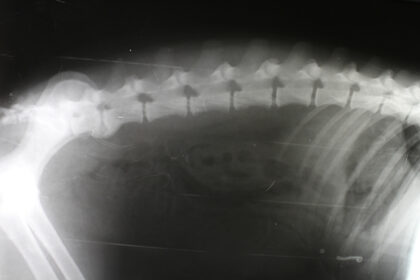 Wedge vertebrae in dogs are congenital malformations of individual vertebrae: the vertebral body is not rectangular but wedge-shaped, because it did not develop properly before birth. Specialists call this hemivertebra. French Bulldogs, English Bulldogs and Boston Terriers are affected above all. However, many of these dogs never have any problems; it only becomes serious when the malformation narrows the spinal cord.
What are wedge vertebrae in dogs?
A healthy vertebral body is roughly box-shaped. In a wedge vertebra, however, one side has not formed at all or only partly, so the vertebra looks like a wedge. As a result, the spine bends at this point, upwards (kyphosis), sideways (scoliosis) or in both directions.
Important to know: wedge vertebrae already develop in the womb. Therefore they are not the result of wrong husbandry, feeding or exercise. Incidentally, in humans the term usually means something else, namely a collapsed vertebra after a fracture. This article is only about the congenital form in dogs.
Which dogs have wedge vertebrae?
Wedge vertebrae can basically occur in any breed. However, they are particularly common in short-headed breeds with a corkscrew or kinked tail, especially French Bulldogs, English Bulldogs and Boston Terriers. In these breeds, studies find wedge vertebrae in the great majority of dogs, often as an incidental finding.
The twisted tail itself is also caused by deformed vertebrae, namely in the tail. In 2018, researchers at the University of California described a hereditary trait (in the DVL2 gene) linked to this tail and to vertebral malformations. That is why animal welfare experts recommend breeding for straight tails.
How do I recognise that wedge vertebrae are causing problems?
| Early signs | Serious signs |
|---|---|
| pain, for example when lifted or when the back is touched | hind legs become weaker or give way |
| unsteady, wobbly gait at the back | dog can no longer walk on its hind legs |
| noticeably curved back | urine or faeces can no longer be held |
| muscle loss in the hind legs |
When should I see the vet?
Many dogs with wedge vertebrae never show any signs. In some, the problems also remain mild and do not change. However, once signs appear, they often progress; one overview puts this at around 85 percent of cases. Therefore: if your dog has back pain or an unsteady gait, have it examined by a vet soon. Take your dog to the practice immediately if it can no longer move its hind legs properly or can no longer hold urine and faeces.
The signs often start in young, growing dogs. In mild cases, the condition frequently stabilises once growth is complete at around nine months.
How are wedge vertebrae diagnosed?
First, your vet examines your dog thoroughly, including neurologically. Wedge vertebrae are easy to see on X-rays. However, whether they actually press on the spinal cord is only shown by more detailed imaging, above all magnetic resonance imaging (MRI). That is why it is usually done before surgery.
How are wedge vertebrae treated?
- No problems: Then usually no treatment is needed. Still, it is worth protecting the back in everyday life.
- Mild, unchanging problems: Here your vet monitors your dog and decides whether painkillers, rest or physiotherapy make sense.
- Progressive or severe problems: Then major spinal surgery may be needed to relieve the spinal cord and stabilise the spine. It belongs in a specialist clinic and unfortunately does not help in every case.
What helps in everyday life?
- Avoid jumping: lift your dog into the car and onto the sofa or use a ramp; avoid stairs where possible.
- Keep an eye on weight: every extra kilo puts additional strain on the back.
- Harness instead of collar: that way there is no pull on the neck and spine when your dog pulls on the lead.
- Non-slip floors: rugs or runners on smooth tiles and parquet give grip.
- Regular checks: especially in young dogs, watch gait and posture and mention changes early.
Frequently asked questions
Can wedge vertebrae in dogs be cured?
Can a puppy get wedge vertebrae from wrong feeding?
No. Wedge vertebrae are congenital and develop before birth.
Do all French Bulldogs have wedge vertebrae?
Not all, but very many. That is why an X-ray of the spine makes sense for breeding dogs.
What is the difference from cauda equina syndrome?
Wedge vertebrae are congenital. Cauda equina syndrome, on the other hand, is usually caused by wear and tear at the junction with the sacrum, above all in older, large dogs.
Sources
- Science for Animal Welfare (formerly UFAW): Hemivertebrae in French Bulldogs, citing Jeffery et al. 2007, Mauler et al. 2014 and De Decker et al. 2024.
- Mansour T. A. et al. (2018): Whole genome variant association across 100 dogs identifies a frame shift mutation in DISHEVELLED 2. PLOS Genetics.
A wedge vertebra is not a verdict but a reason to look more closely. With attention in everyday life and a good vet at your side, many affected dogs lead a happy life.
Read more: Cauda equina syndrome in dogs · Paralysis in dogs · Common illnesses in Pugs and French Bulldogs

From our range: DOG FIT by PreThis® JOINTS elements and VITAMIN B as a combination set. JOINTS elements contains glucosamine, collagen, MSM and chondroitin, VITAMIN B all eight B vitamins. You can find the set in our shop.

Our daily inspiration is the special moments with our dogs. Here we share this enthusiasm and invite you to become part of the DOG FIT community on our social media channels.
The content of the articles is for general information purposes only and does not replace diagnosis or treatment by a veterinarian. This information does not constitute medical advice and should not be construed as such.
Comment area
We look forward to your comment


Weitere Beiträge


