
Removing tartar in dogs - natural tooth cleaning
- Why should you care for your dog's teeth?
- How does tartar develop in dogs?
- What does the term "species-appropriate" mean?
- The consequences of tartar
- Can the vet help with tartar?
- Tooth cleaning with the power of nature
- How it all began
- The most important advantages at a glance
- The application
- Are there limits to natural tooth cleaning?
- Our offer
Dogs have an impressive set of teeth that they have inherited from their ancestors, the wolves. However, many dogs nowadays have problems with tartar, plaque, bad breath and inflamed gums. Unlike wolves, dogs seem to be more susceptible to these problems, for the wolf has only a little tartar in old age, if at all. Well, wherever humans have had a hand in it, things have rarely turned out well for animals.
Unsuitable food and chewing material, over-breeding and dwarf-breeding as well as humanisation are the main reasons. Fortunately, the view is now held that dental care is important for dogs too. Yet unfortunately very few dog owners know how this works properly. They go on trustingly heeding the recommendations of friends, breeders and vets, and thereby the food industry often associated with them, give the dog so-called denta-sticks full of additives and actually believe that discount-store food is healthy and that dry food cleans the teeth.
"Strange people," Doggy would say now. "Why don't they just learn what is good for me? After all, I am a member of the family, and it surely can't be too much to ask to read a book on the subject. But they haven't got time for that. Opening a sack and tipping strange lumps into the bowl is just so nice and convenient. If only they would read the declaration for once, but even then, they don't understand it. And then I have to eat it as well; even a blind person can see that something like that can have nothing to do with nutrition. Well, and then I got tartar."
Why should you care for your dog's teeth?
Many dog owners ask themselves why they should bother with the dental care of their four-legged friend. After all, a wild-living wolf doesn't need any tooth cleaning either, does he? That, however, is not true; a wolf too needs tooth cleaning, and nature has built the tartar prophylaxis in directly. But in the dog it no longer works, and humans are to blame for that.
The breeding of dogs has, over centuries, placed less value on healthy teeth than on external features such as the coat. In addition, some breeds have been bred unnaturally small, which leads to teeth being far too close together. Further factors that can lead to dental problems in dogs are the food and the chewing material.
Unlike a wolf, who devours his prey completely, hide and hair, and thereby carries out his natural tartar prophylaxis, today's dog food is often not optimal for dental health. Ingredients such as grain and sugar can encourage plaque and attract harmful oral bacteria, which can ultimately lead to tartar. Moreover, the usual food offers hardly any opportunity for the mechanical cleaning of the teeth. Dry food is the unhealthiest thing you can inflict on a dog. Something like that does not belong in any bowl. Is this new to you? Then please, for once, seriously get to grips with species-appropriate nutrition instead of blindly trusting food manufacturers, for they are not always your friend! Your dog, your responsibility, and tartar is home-made in 90% of all cases.
How does tartar develop in dogs?
 Tartar in dogs develops through a combination of factors. During eating, deposits form on the teeth from food components mixed with saliva and bacteria present in the mouth. The bacteria in these deposits produce acids that attack the tooth enamel, and foul-smelling gases that lead to bad breath.
Over the course of time these deposits harden, through the mineral components of the saliva, into hard, brownish tartar, which cannot be removed with a toothbrush either. Certain dog breeds, such as the Chihuahua, Poodle, Dachshund, Pug and Shih-Tzu, are, because of their breeding-related far too narrow jaw shape and teeth that are too close together, more susceptible to tartar formation than others. Nature had not intended it that way.
If you happen to have such a dog and are certainly very fond of him, these breeds would nonetheless not occur like this in nature, for they would scarcely be capable of survival. Here humans have had a hand in it. Breed-specific illnesses such as increased tartar, patellar luxation, joint, vertebral and intervertebral disc problems are just some of the possible consequences that breeds bred predominantly to human wishes have to contend with nowadays. All the greater is the responsibility that rests on the shoulders of the owners to provide for their health in a species-appropriate way. Unfortunately, many do not know how this works properly. The very term "species-appropriate" often prompts a shrug of the shoulders.
What does the term "species-appropriate" mean?
The term "species-appropriate" refers to keeping and feeding dogs in a way that corresponds to their natural needs and instincts. Species-appropriate keeping means that the dog's living environment does justice to his natural behaviours and needs. This includes sufficient opportunity for exercise, access to fresh air and sunlight, appropriate social contact with fellow dogs, the fulfilment of breed-specific drives as well as a safe and comfortable shelter.
Species-appropriate feeding of dogs is about offering them food that corresponds to their biological requirements. Dogs are only 70% carnivores and need a balanced diet that is rich in high-quality and above all fresh animal proteins, healthy fats, essential vitamins and minerals. A species-appropriate diet generally includes a fundamental mixture of muscle meat, heart, lung, stomach, offal, tendons, cartilage, skin and fur, bones, vegetables, fruit, berries, herbs, nuts, egg and fats. It is important to choose high-quality and natural ingredients and above all to avoid industrial wet and dry food with artificial additives, preservatives, attractants, flavourings and colourings. Unfortunately, very few know how to interpret a declaration correctly, nor how a correct declaration of meat and other ingredients ought to look, nor that free of sugar, grain and artificial additives is not the same as these not being contained in it.
Species-appropriate keeping and feeding aim to promote the well-being and health of the dog by doing justice to his physiological and psychological needs. Learning all of this lies in the responsibility of the human towards the dog. If this cannot be fulfilled, species-appropriate keeping is not possible.
I assume that every reader will give their agreement to this. Yet what does reality look like? Unfortunately, very often completely different. Industrially manufactured wet or dry food, often from the discount store or from the usual (online) fast-food outlets for dogs, too little exercise, hardly any mental work and social contact, and exaggerated humanisation are the order of the day and lead not only to illnesses but also to behavioural disorders.
The dog does a wee out of joy, barks at strangers or yaps over every trifle, doesn't get on with other dogs, jumps up at someone like a circus dog and is then also trained to have his teeth brushed. Species-appropriate dog keeping has nothing to do with circus lessons. Yes, where are we? Is no one any longer aware of the responsibility towards the dog, a social living being and above all a member of the family? No, not a human member of the family, but a dog as a member of the family; those are two different pairs of shoes! And with that, back to the actual topic ...
The consequences of tartar
Alongside frequently occurring bad breath, inflammation at the necks of the teeth can accumulate and lead to chronically inflamed gums and bleeding gums. This can in turn lead to a receding of the gums, pain when eating, refusal to eat as well as loosening and even loss of the teeth. In the worst case, germs and bacteria from the mouth reach the organism via the bloodstream and infect other parts of the body too. In this way, damage to the heart, kidneys and liver can also occur, for example. It is therefore important to remove tartar and, as mentioned, it is unfortunately almost always home-made.
Can the vet help with tartar?
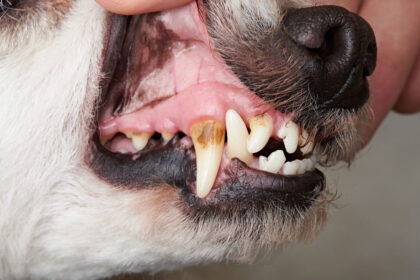 A tooth cleaning at the vet's can be a solution, and the vet is pleased about every new customer. Easily earned money, and for that reason there is no reason for him to explain how tartar can be avoided in future either. Dogs also mostly react very stressed to the unpleasant treatment, which is why a general anaesthetic is necessary in order to avoid panic reactions and injuries to the four-legged friend and to the vet through resistance.
However, one should think carefully about whether to have a general anaesthetic carried out "merely" for tooth cleaning. Many dog owners fortunately regard this as excessive, for particularly in very small, pre-ill or older dogs the risk of dying in the process can be increased.
The costs, too, should not be underestimated. Charged at the single rate, from around 250 euros, and this can quickly become around 450 euros too. A tooth cleaning at the vet's is also not sustainable - prevention is not in the interest of many vets. Fortunately, there are also very good and above all fully trained vets, but you have to find them first!
That is why many dog owners look for alternatives that are gentle on the dog and on the wallet. There is an effective and, for the dog, completely stress-free alternative for tackling even stubborn tartar. Find out now which method this is!
Tooth cleaning with the power of nature
 Before considering an "alternative" tooth-cleaning method, it is important to feed the dog sensibly and to give him suitable chewing material. This is indispensable; natural cleaning only works if the entire chain is natural and species-appropriate. Unfortunately, however, most dog food - a full 90% - consists of industrial food (wet and dry food), which could also be described as the McDonald's for dogs.
But why is this food fed by so many nonetheless? The answer is simple: it is convenient to open the sack and put the strange lumps into the bowl. Many dog owners also believe that the food is good because the manufacturers "promise" it in the advertising. Dog owners are dealing with the food industry, and that is not always the dog's friend. There are only a few exceptions.
Book tip: "Dogs would live longer if ..." by Dr Ziegler (veterinary surgeon). The book is, so to speak, the driving licence for all dog owners and informs, written in a way understandable for lay people, how dogs ought to be fed, how many vets and the food and pharmaceutical industry work hand in hand, and above all how dogs are kept in a species-appropriate way.
Since you have read this far, the child - or rather the dog - has probably already fallen down the well, and now the tartar first has to be removed. Ways to support the dental health of your dog can be pursued through natural products that contain various types of algae, plants and herbs. These contain special compositions that are able to soften hard tartar so that it can come loose. This method is effective, healthy and gentle on your dog's teeth. Above all it is a stress-free alternative for reducing tartar. Bear in mind nonetheless that it is a treatment of the symptom and not of the cause!
How it all began
Over 20 years ago our team searched for a stress-free and healthy solution for dogs for dental care. For even back then it was foreseeable what else was going to come our dogs' way, and over the last 15 years dental diseases in dogs have then positively exploded. In conversations with our animal naturopaths and herbal experts we became aware of certain types of algae, plants and herbs. After further research and the development of a manufacturing process for extracting the active substances and obtaining a granulate from the raw materials, DOG FIT by PreThis® WHITE dental plus came into being some time later.
Why a granulate? It was important to us that WHITE dental plus can simply be mixed into the food, in order to make the treatment for your dog and for you as simple as possible. Incidentally, the granulate has nothing to do with any friction against the teeth. The active substances pass to the teeth via the saliva and soften the tartar.
WHITE dental plus is vegan and 100% natural. It is by now recommended by many modern vets, such as Dr Sibylle Ott (veterinary surgeon), by animal naturopaths as well as by our partners, such as for example Ramona Houscht and Franziska Herre of the Martin Rütter DOGs dog schools in Heidelberg and Erfurt.
The most important advantages at a glance
- 100% natural and vegan
- against tartar and plaque
- no vet, no anaesthetic
- saves money and nerves
- supports whiter teeth without stressful tooth brushing
- is simply mixed into the food
- is a gentle treatment for dog teeth
- contains important amino acids, vitamins, minerals & trace elements
- GMO-free, free of gluten, fructose, yeast, soya, artificial flavourings and additives
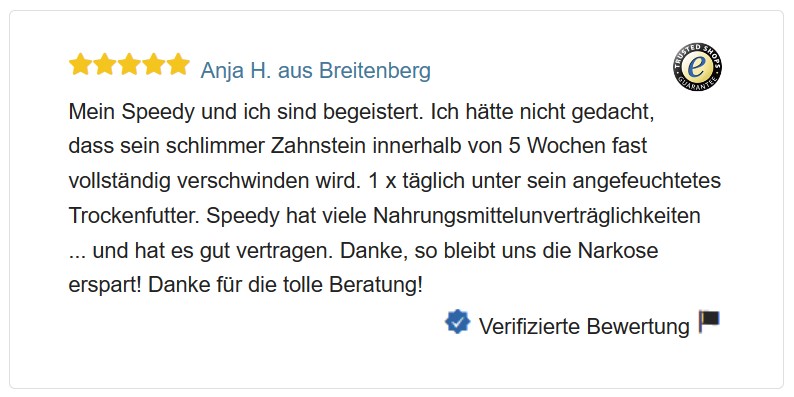
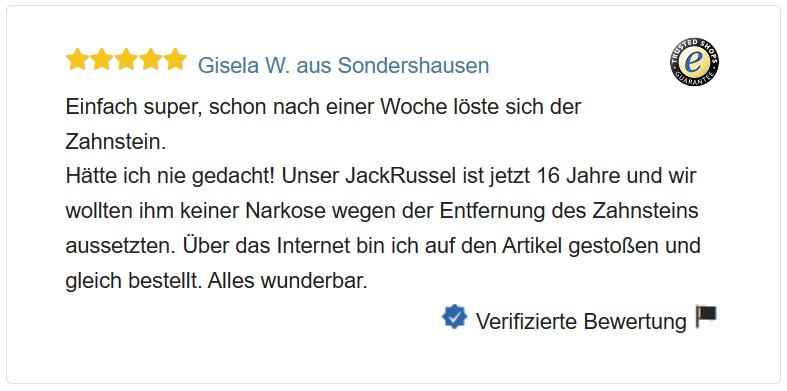
The application
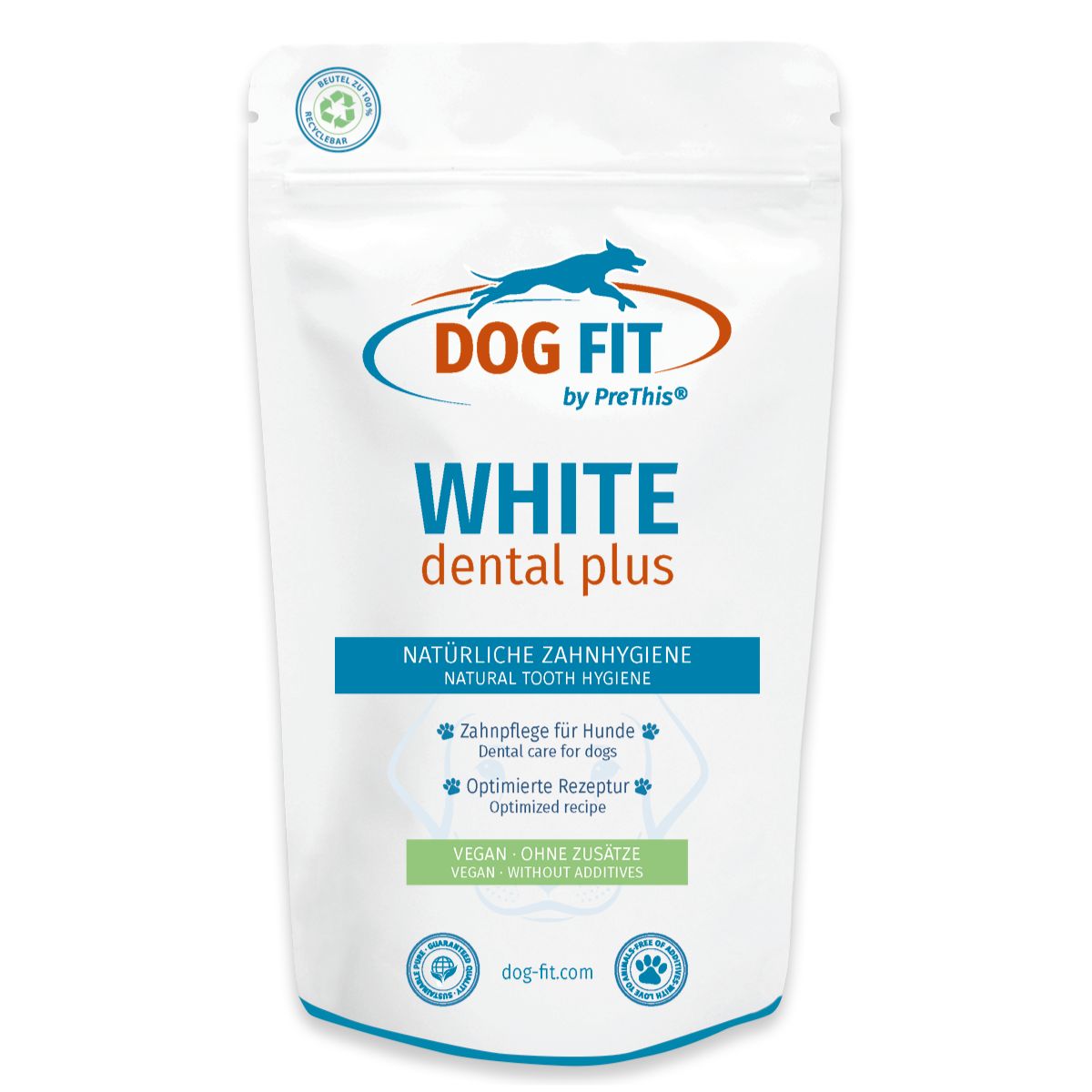 WHITE dental plus is quite simply mixed into the food.
Per 10 kg of dog weight, 1 small measuring spoon daily (which is of course included). One tin is sufficient for 2 months for a dog weighing up to 10 kg. You will find the dosage recommendation for very small dogs of up to around 2 kg in the shop under the heading Application and in the FAQs.
Important to know: natural products need time to unfold their effect. You should therefore be patient and wait at least 6 to 8 weeks until the tartar begins to soften. With very thick and old tartar it can also take 12 weeks or longer. Do not forget that the food, too, has a great influence on dental hygiene. WHITE dental plus is not a miracle solution that immediately provides white teeth, for it combats the symptom and not the cause. Pay attention to a healthy diet and plenty of chewing material.
Are there limits to natural tooth cleaning?
Yes, there are also limits to natural tooth cleaning. If the tartar is already very thick, mineralised, lumpy and spread over the full surface of many teeth, and inflammation of the gums is clearly visible, then unfortunately too long has been waited. We ask ourselves again and again why?
Nonetheless we recommend trying it, in order to possibly still avoid a tooth cleaning under anaesthetic. In such cases the bacterial load in the mouth and throat, and possibly already in the body, is usually quite high, for the bacteria find an ideal breeding ground in the tartar and deposits. They trigger bad breath and inflammation and can cause heart, liver and kidney problems. For this reason the joint administration of WHITE dental plus and FRESH is then required. FRESH contains antibacterial herbs in order to combat the bacteria. With very heavy tartar infestation the use of a thumbnail or a scaler can also be necessary. If, however, the tartar and above all the inflammation are already far too pronounced, only a tooth cleaning under anaesthetic will help, in order to prevent worse.
Our offer
Normally WHITE dental plus costs 25.95 euros (RRP), but thanks to our offer you receive WHITE dental plus for only 22.95 euros from us in the original DOG FIT shop.
Together with your 5% new-customer voucher DOGFIT you can save on the purchase of your first tin! From two tins onwards it becomes even cheaper per tin, and shipping is free. For very large dogs we have a 5 + 1 offer: buy 5 tins, get 1 tin free. From a basket value of 50 euros you can select our advice paperback "Health for your dog" and from 100 euros a comprehensive food check as a free bonus. A purchase with us is always secured with the Trusted Shops buyer protection!
Take care of healthy teeth now! (click)
Use your 5% new-customer discount! Code: DOGFIT
We wish you and your furry friend lots of health!
Your team from DOG FIT by PreThis®

Our daily inspiration is the special moments with our dogs. Here we share this enthusiasm and invite you to become part of the DOG FIT community on our social media channels.
The content of the articles is for general information purposes only and does not replace diagnosis or treatment by a veterinarian. This information does not constitute medical advice and should not be construed as such.


