
Grass eating – is the dog allowed to do that?
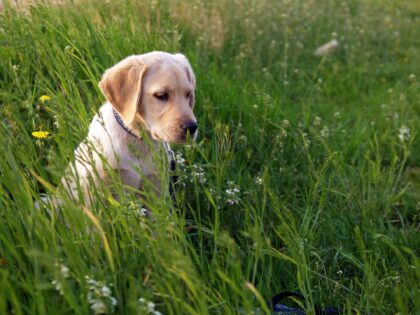 Especially in spring, when the fresh young grass grows, you see a lot of dogs eating grass. To this day there is no clear scientific explanation for it. A lack of vitamins or minerals is often suspected – yet studies show that even perfectly nourished dogs like to eat grass. In our daily advice at DOG FIT, we can reassure most owners: as a rule, this behaviour is completely harmless.
Is grass simply tasty – or is there more to it?
Young grasses contain a lot of plant protein and simply taste good to many dogs. So often there is no deeper reason behind it. The old belief that a dog eats grass to "clean" its stomach and make itself vomit cannot be confirmed in such general terms – that is mainly a topic for cats and coat care. Still, it is worth taking a closer look, because in some cases grass eating really does have to do with the stomach.
Grass eating and heartburn
Some dogs deliberately eat grass when stomach acid is troubling them – for example with heartburn caused by rising acid (reflux). Behind this lies less a "neutralising" than an instinct: the blades irritate the stomach and trigger a gag reflex, so the dog gets rid of the excess acid. If your dog reaches for grass mainly after meals, while burping or with audible smacking and swallowing, heartburn may be the cause. Smaller portions spread throughout the day and easily digestible food relieve the stomach. Alongside this, a specialised supplement can act as stomach protection and an acid binder – more on that below.
Too much bile – the "hunger bile"
Another often underestimated trigger is a stomach that is too empty. If it stays empty for a long time – typically overnight into the early morning hours – bile can build up and irritate the stomach lining. The dog feels queasy, eats grass and sometimes vomits a yellowish, foamy mucus. This "hunger bile" (also called bilious vomiting) classically occurs in the morning before feeding. Here it usually helps to split the daily ration into several small meals and to offer your dog a small snack late in the evening, so the overnight fasting phase is shorter. Here too, a specialised supplement can support the irritated stomach lining and bind excess acid.
Which ingredients support the stomach
For a sensitive dog's stomach, a few natural ingredients have proven their worth by protecting, binding and bringing digestion back into balance. Flaxseed and psyllium husk form a gentle mucilage layer with liquid that lays protectively over the irritated stomach lining and binds excess acid. Inulin and Jerusalem artichoke provide prebiotic fibre and promote healthy gut flora. Ashwagandha is regarded as an adaptogenic plant that can help balance stress-related stomach complaints – and stress is a common trigger for increased stomach acid. Neem leaf powder is traditionally used to support the stomach and digestion. Such a combination can calm the stomach without disturbing natural digestion.
When you can simply allow grass eating
If your dog only eats grass occasionally, seems lively and shows no other symptoms, you can calmly allow it – it is part of the completely normal repertoire of many dogs. Curiously, grass eating is even contagious: again and again you can observe whole groups "grazing" together. You should only pay closer attention if grass eating becomes very frequent or is accompanied by repeated vomiting (especially of yellow bile or foam), loss of appetite, listlessness or diarrhoea. Then a visit to the vet is advisable to rule out gastrointestinal problems.
- Grass eating is usually completely normal behaviour with no disease value
- A link with nutrient deficiency has not been scientifically proven
- With heartburn, the dog instinctively eats grass to get rid of excess stomach acid
- On an empty stomach, "hunger bile" irritates the lining – small, spread-out meals and a targeted supplement help prevent it
- Ingredients such as flaxseed, psyllium husk, inulin, Jerusalem artichoke, ashwagandha and neem can protect and calm the stomach
- Frequent grass eating with vomiting, loss of appetite or diarrhoea should be checked by a vet
I wish you a wonderful day with your four-legged friend.

Our daily inspiration is the special moments with our dogs. Here we share this enthusiasm and invite you to become part of the DOG FIT community on our social media channels.
The content of the articles is for general information purposes only and does not replace diagnosis or treatment by a veterinarian. This information does not constitute medical advice and should not be construed as such.


