
Draught dog sport, dog scooter & co – dog sport trends at a glance
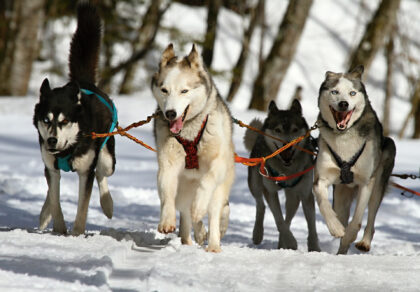 That many dog breeds are by no means content simply to lie on the sofa as a family dog or to lounge around the garden as a yard dog is something more and more dog owners are realising. That is why many dog lovers use dog sport to give their four-legged friend appropriate exercise. Alongside the better-known sports such as protection dog training, agility and the like, a relatively new trend in this country is increasingly pushing to the fore: draught dog sport. Whether jogging, with a bike or a special cart – it is not only huskies that have great fun pulling. We give you a little overview of this versatile sport.
Why draught dog sport of all things
Mushing is the technical term for draught dog sport and comes from a region where the snow-covered landscape could only be reached with the help of dog teams. This form of work was almost second nature to the dog. The close cooperation within the pack and with the leading person, as well as the long running distances, matched the animals' natural needs. Nevertheless, draught dog work long remained a marginal phenomenon. Only in more recent times, when the topic of species-appropriate exercise and occupation for the family dog increasingly came into focus, did draught dog sport also become discovered by a broader public.
In contrast to other sports, which usually concentrate more on a particular aspect such as obedience or agility, draught dog sport is more broadly based. On the one hand, the dog has the opportunity to use its innate joy of running and to live out its species-typical drive within a meaningful framework. On the other hand, close cooperation in the team of human and dog is required, which strengthens the bond. The training can be geared towards endurance or speed, with the dog's head and body always being challenged in equal measure.
The suitability of other breeds for this sport
When people hear of draught dog sport, they usually think automatically of huskies. Indeed, sled dogs were bred over a long time into perfect draught dogs, since they are keen runners, have endurance and are robust. However, one must not forget that these dogs have to contend with other problems in this country. Their dense coat tends, in our regions, to make them overheat and, as a result, to be only of limited performance. That is why the scene is increasingly opening up to other breeds. Some of the large hunting breeds too, such as the German Wirehaired Pointer or the pointer, have proven very suitable. Strictly speaking, almost every dog above a certain size is suitable for draught work, to live out its urge to move.
There is no fixed rule of thumb for size or weight. Here the choice of variant, the chosen vehicle and the owner's weight are the deciding factors. For the animal's welfare, however, certain basic characteristics have to be met. These include a certain physical strength, so that it is at all possible for the dog to perform the work. Naturally, the dog should also be fully grown, so that the joints in particular have reached a certain basic stability before they are put under strain. Caution is advised where there is a tendency towards conditions such as arthrosis or hip dysplasia. Here it is advisable first to consult a veterinary practice before starting the sport. The dog's cardiovascular system should also be checked over as a precaution before training begins.
Equipment for getting started
To be able to practise draught dog sport, a suitable dog alone is not enough. In any case, you need a special pulling harness that distributes the load evenly and gently across the body. In addition, an elastic, shock-absorbing line is necessary. On top of this, an appropriate pulling vehicle has to be chosen to match the level of training. In our holistic approach we attach great importance to the equipment respecting the dog's anatomy.
- Special pulling harness for optimal pressure distribution across the chest
- Elastic line with shock absorption to protect the spine
- Sturdy attachment to the vehicle by means of a special antenna
- Good equipment for the human too, such as a helmet and suitable gloves
Draught dog sport on foot
This variant is becoming ever more popular, with dog and owner out and about as a team in the terrain. They are connected by an elastic pulling line that is attached to the dog's harness and the human's waist belt. Off they go into the terrain, with the dog taking on a large part of the forward pull. This makes it possible to reach astonishing speeds of up to 30 kilometres per hour. This form is ideally suited as an entry point, to introduce the dog to the work.
Draught dog sport with the bicycle
Here the dog is attached to the bike with a pulling harness and shock-absorber line on a special antenna. This prevents the line from being drawn into the wheel, which could lead to serious accidents. The dog takes up the pull in front of the bicycle, while its human can support it by pedalling. This makes it easy to control the training effect and to caringly counteract overexertion. It is also advisable to fit an emergency release that makes it possible to separate the team quickly if necessary.
Draught dog sport with the kick scooter
Riding with the kick scooter differs only in a few points from cycling. It is a special, particularly sturdy scooter with a low centre of gravity. Here the dog can be relieved of the load less than with cycling, which is why the strain is higher. The dog frequently works slightly against the brake, which requires a lot of strength. Here too, an antenna, a good harness and a special line are indispensable for safety in the terrain.
Draught dog sport with the kicksled
Since the wish to enjoy the winter together with the dog is great, the kicksled has become established. This is a light sled variant that can be pulled by just one dog. It already glides well on a light covering of snow. For this variant a suitable brake mat is essential, since such models often have no integrated braking device.
Further pulling vehicles for powerful dogs
Besides the options mentioned, there are numerous other vehicles. A special cart is suited primarily to powerful, strong-pulling dogs. It is a four-wheeled vehicle on which the dog handler sits and cannot actively support the animals. Also worth mentioning is the two-wheeled cart or a three-wheeled variant on which you stand. The good thing about the large selection is that every interested person can find a vehicle that matches their dog's abilities.
This article serves as general information and does not replace a visit to a veterinary practice. If you have questions about physical fitness, expert advice should always be sought.

Our daily inspiration is the special moments with our dogs. Here we share this enthusiasm and invite you to become part of the DOG FIT community on our social media channels.
The content of the articles is for general information purposes only and does not replace diagnosis or treatment by a veterinarian. This information does not constitute medical advice and should not be construed as such.


