
Breed portrait: Weimaraner
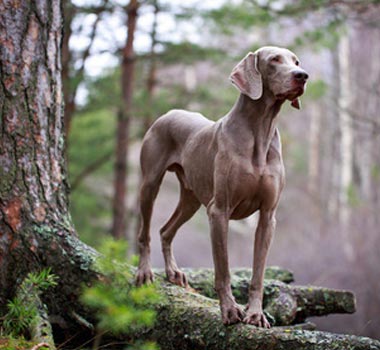
Fascinating beauty with special requirements. Probably no other breed has more potential to become a fashionable dog: the mere sight of a Weimaraner with its silvery, gleaming coat, its supple movements, its proud bearing and its noble, aloof expression melts many a heart. So it really surprises no one that more and more people wish to have one of these graceful animals at their side. And yet the beautiful Weimaraner is, unfortunately, only suited to a very limited extent as a family dog.
A brief history of the breed
The Weimaraner was first bred as a distinct breed when the Grand Duke of Weimar, Karl August, captivated by their uncompromising drive when hunting, began to breed these pointing dogs deliberately. In 1890 they were finally recognised as a breed and, from then on, were for a long time kept almost exclusively as working gundogs.
Nowadays, in times when dogs are hardly regarded as working animals but rather as family members, the Weimaraner too finds a place in the hunting lodge ever less often and is increasingly favoured as a family dog as well. But that is precisely what proves difficult: after centuries of selective breeding according to hunting criteria, the Weimaraner is indeed an ideal hunting companion, but in ordinary life as a family dog it is often hopelessly under-challenged.
The Weimaraner's appearance
The Weimaraner's appearance is impressive: its silver-coloured coat is so noble that it harmonises wonderfully with its graceful and powerful frame. With a shoulder height of 60–70 cm and, depending on size, a weight of 25–40 kg, it is one of the larger gundog breeds and shows the typically elegant bearing of the classic pointing dogs.
In addition to the common variety, which has a short, strong coat with no notable undercoat, occasional crossing with herding dogs also gave rise to a long-haired type, which is, however, very rare. The only difference the long-haired Weimaraner shows compared with the short-haired type is its medium-length, silky-soft coat.
The Weimaraner's character traits
Owing to its breeding as a working dog for hunting purposes, the Weimaraner is above all one thing: eager to work. It has a very strongly developed hunting drive, which can definitely become a problem when kept as a family dog, since, if insufficiently occupied, it tends to seek out its own, sometimes aggressive, ways of working off that drive. At the same time, it is precisely this strong hunting drive that also makes it such a versatile working gundog. In terms of temperament, the Weimaraner is rather a calm companion whose personality develops relatively late. Many of its character traits only emerge after 2–3 years.
The Weimaraner is a very intelligent breed that seeks mental occupation and is happy to carry out the tasks it is set. Together with its affectionate nature, this makes it an easy-to-handle dog that, with a little expertise, can be trained well and willingly. Nevertheless, it needs consistent training and reliable leadership, otherwise it may use its intelligence to take over the leadership of its „pack“.
However, the Weimaraner's strong bond with „its“ people also has a downside, for it develops a strong protective drive towards its human pack. This is where the deliberately bred „sharpness towards people“ comes into play: while other dogs often only bark or nip at arms and legs, a Weimaraner often goes straight on the offensive and, in an emergency, does not shy away from seriously attacking its „opponent“. The reason for this is that the Weimaraner was used not only for hunting but also to fend off poachers. Correspondingly high is the silver gundog's readiness to confront even people uncompromisingly if it believes there is a need to do so. Until a few years ago, Weimaraners approved for breeding even had to demonstrate their sharpness towards people in a test.
Enchantingly beautiful, but anything but uncomplicated
As in many a case, the Weimaraner hides behind an enchantingly beautiful appearance a complicated character that requires expertise and absolute consistency. Anyone who thinks they will acquire one of these silver-coloured dogs as a decorative accessory will quickly be overwhelmed, because, much like the Border Collie, the Weimaraner needs intensive mental work as well as physical activity. If the dog cannot (as is so often the case) be used for hunting, mantrailing or tracking work are good options for meeting this breed's needs – though this does require time and commitment.
Because of the high demand for Weimaraners as family dogs, the number of breeders advertising their (by their own account) non-hunting breeding lines is now rising. That sounds tempting to some – a beautiful dog with high intelligence and no hunting drive! Unfortunately, it is not quite that simple: for even though the breed is now increasingly bred as a show and family dog, centuries of breeding as a working gundog cannot be undone so quickly. While outward characteristics can be changed quickly through targeted mating, character traits often remain astonishingly constant for a long time. And it is precisely traits such as sharpness towards people or the strong hunting drive that quickly become a dangerous problem under weak leadership.
But of course it must also be said that there are indeed Weimaraners in which the protective drive and the joy of hunting are less strongly pronounced. The fact that the parent animals showed no interest in hunting does not, however, mean that their offspring cannot have a strong drive. And two parent animals used for hunting are still no proof of hunting suitability. As an inexperienced person, though, you can often only recognise these predispositions with great difficulty – especially in young dogs whose character is not yet fully formed. That is why the Weimaraner, for all its merits, is by no means suitable as an easy family dog for everyone.

Our daily inspiration is the special moments with our dogs. Here we share this enthusiasm and invite you to become part of the DOG FIT community on our social media channels.
The content of the articles is for general information purposes only and does not replace diagnosis or treatment by a veterinarian. This information does not constitute medical advice and should not be construed as such.


