
Breed Profile: Akita Inu
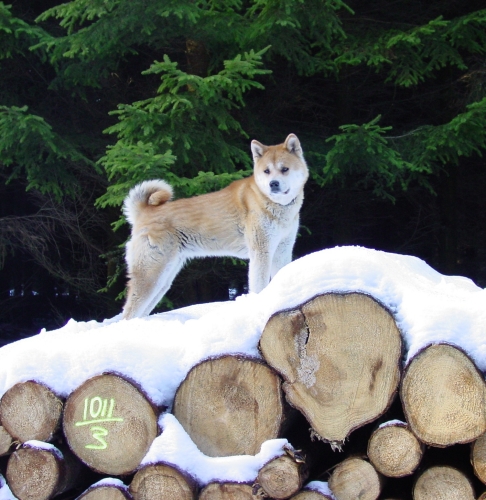
The Akita is a strikingly beautiful, imposing dog that radiates self-confidence and dignity. The “dog of Akita” is one of the ancient Japanese breeds, whose appearance recalls both Nordic dogs and spitz breeds, yet which possesses a very distinctive character. To acquire one purely on the strength of its impressive appearance would be irresponsible!
Breed history
Akitas are a very old Japanese hunting and guard-dog breed. They have probably existed since the beginning of our era, or perhaps even longer. Even today they seem very primordial, both in appearance and in temperament.
Appearance
In the year 2000, Akita breeding was officially split into two types: the elegant, long-legged Japanese type on the one hand and the comparatively heavy, stocky American type on the other.
American Akitas have a shoulder height of 61–66 cm in bitches and 66–71 cm in dogs. The Japanese dogs are on average a little more delicate, at 58–64 cm and 64–70 cm respectively.
The face looks more open than its reserved nature would suggest, with almond-shaped eyes and furry pricked ears – this comes across especially beautifully in the red variety. The build is square, with steeply angled limbs and a firmly curled tail carried over the back. Akitas come in many colours. A breed-specific feature of the red and black Japanese Akitas is the lighter undercoat that shimmers through. The American Akitas are often piebald.
The coat is so thick and dense that an Akita can quite happily let itself be snowed under until only the tips of its ears show. On the other hand, this means that in summer walks should be moved to the evening and morning hours, when it is still cooler. The coat is weatherproof but not waterproof; when swimming (which happens rarely!) it soaks itself full.
Like other primordial breeds, Akitas do make barking sounds, but actual barking or even yapping is rare.
Character traits
The Akita is a reserved, outwardly calm, self-assured and hierarchically minded dog – and this nature is to be respected. They are not among the “daftly cheerful, harmless” dogs, but insist on correct social behaviour and on the observance of their relatively large individual distance. If this is not respected, an Akita will defend itself. Usually a single look is enough – there are few dogs that can withstand the gaze of an Akita! But if a strange dog really does become intrusive, an Akita will put it in its place.
Really, every dog owner ought to grasp this: which of us would put up with being loudly accosted, or perhaps even clumsily touched, by complete strangers while out and about? Yet many people expect exactly this tolerant behaviour from dogs. If an Akita fends off the intrusiveness of such an ill-mannered animal with no sense of distance, it is quickly said that the Akita is aggressive. For an Akita owner, therefore, even more than for other dog owners: choose carefully where and with whom you let your dog run free.
Within the family, too, Akitas think in hierarchies: they often have a single favourite person to whom they are devoted with all their heart and who cannot really be replaced. Children are respected, but not necessarily acknowledged as authorities. The children should disturb the dog neither while it is eating nor on its resting place when it wants its peace.
The Akita’s need for exercise is best met with long walks; they are certainly not ideal sporting dogs. The retrieving scenes in the film about the legendary Hachiko are quite realistic: an Akita grasps the idea of retrieving, but often does not grasp what it is supposed to be good for. Some owners report that their Akita would rather watch the other dogs working than needlessly waste energy itself.
Anyone who has once had the honour of being loved by an Akita knows the unique bond of these proud animals.

Our daily inspiration is the special moments with our dogs. Here we share this enthusiasm and invite you to become part of the DOG FIT community on our social media channels.
The content of the articles is for general information purposes only and does not replace diagnosis or treatment by a veterinarian. This information does not constitute medical advice and should not be construed as such.


